

Let’s be honest. This question doesn’t start with a spreadsheet. It starts with a feeling; maybe you’ve been serving biryani from your home kitchen for five years, and everyone around you keeps saying “yaar, you should open something”. Or maybe you’ve scouted three locations, done your rent math, and you’re still not sure if paying ₹1.5 lakh a month for a spot in Mumbai is actually smart business.
Whether you’re a first-time entrepreneur or a working professional looking to transition into food, the food truck vs restaurant debate is one of the most common and valid questions for a first-time entrepreneur in the food industry.
By 2028, the food services market in India is going to reach ₹ 7.76 lakh crore. Within that, the sector for mobile food is increasing by 9% a year and will hit USD 280 million by 2030. There is money to be made. The real question is, which business model is going to give you more of that money?
This guide shows you the real costs, the real margins, the real timelines for the tradeoffs, and everything you really want to know that is specific to India, and without the fluff. Let’s get clear on what we’re talking about.
This is the first of its kind, honest evaluation for these two business models. The restaurant and food truck models themselves have both undergone significant changes and improvements over the last 5 years in India.
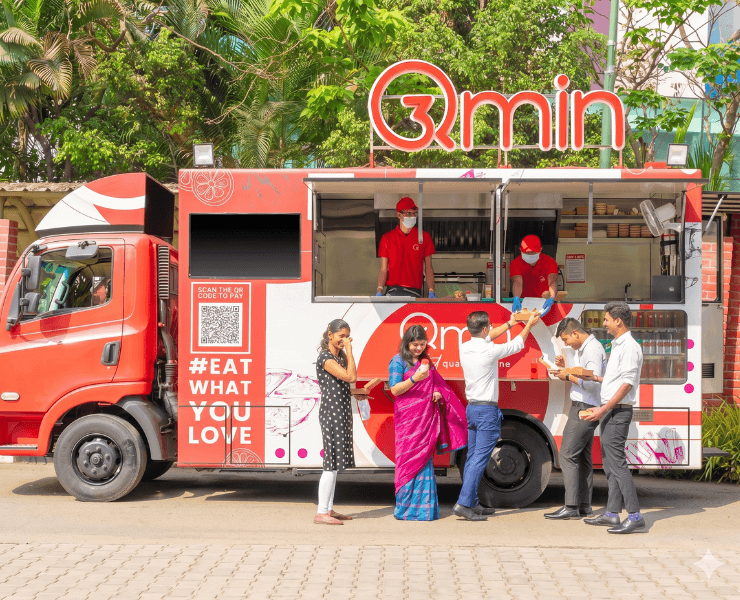
These days, food trucks in India are far more advanced than just a mobile cart with a pan. Nowadays, food trucks are built with a commercial kitchen with gas burners, an exhaust system, branding, a water tank, and a refrigeration system, all built with a custom fabrication system built on a Tata Ace or food trailers. A food truck is built to be an advanced mobile commercial kitchen. Those owners who pay attention to that mobile infrastructure are going to be in business for a long time, and those that are cheap with their fabrication are going to find out the hard way why cutting corners is a bad idea, in a maximum of six months. For the most part, a restaurant is simply a casual dining setup with twenty to forty covers that is set up in a commercial space in a metro or tier 2 city.
What is the Investment Reality?
What are the costs associated with getting a food truck and restaurant setup?
The main food truck vs restaurant setup difference you need to be aware of is that in India you will need a lot more cash to be able to set up a restaurant as compared to a food truck.
What does it cost to open a restaurant?
Opening a restaurant in a metropolitan Indian city is not cheap. The deposit you’ll pay for a commercial lease is very likely going to be the biggest initial expense. That’s before you pay for any equipment! The cost of an equipped kitchen, premium interior design, a whole legal license to operate (FSSAI, trade license, fire NOC, GST), furniture, a fitted-out restaurant, a branded restaurant, and funds to keep running for a few months while waiting on customers is a serious burden that many people dramatically underestimate.
A reasonably good restaurant in Indian cities like Mumbai, Delhi, and Bengaluru takes a real capital investment. The same goes for the monthly expenses of gas, electricity, rent, and a full staff that remain even in slow months. That is how the restaurant model ends up quietly destroying those who jump in without realizing the pressure.
What are the costs of opening a food truck?
Compared to restaurants, launching a mobile food unit in India is a fairly cheap fabrication and equipment build. Add some basic licensing and two months of operating funds, and you’ve got a good investment for a fully branded food truck equipped for service. A restaurant owner gets no value from their initial outlay. You’re extremely unlikely to recoup your investment by selling a restaurant. Opening a restaurant is like throwing away your life savings.
A food truck costs three to five times less to launch than a comparable restaurant. For an entrepreneur putting in their own savings, that’s not a small difference; instead, it’s the difference between risking your savings or risking everything.
Profit Margins: The Part That Surprises Most People
Margins are where food trucks and traditional restaurants really begin to vary. This is the part of the process that blows the minds of MOST people.
A traditional restaurant business is more expensive. Costs to run a restaurant are higher than costs to operate a food truck. Even successful casual restaurants will only net you real value from three to twelve percent of total revenue.
Think about a successful restaurant business. You’re going to be paying a ton of costs still. After paying costs, your traditional restaurant will only make you a modest amount. A healthy gross margin before calculating costs can translate to a bad margin after costs of rent and labor. You can easily make a ton of money and still come out with nothing. It’s not about the price you put on each plate. The burden is imbalanced fixed costs. Rent is at the top of the list. You pay these costs no matter how many people you serve. A slow day in July pays the same as a busy day in December.
Structural advantage of food truck margins
The biggest cost, rent, is no longer in the food truck model, and costs are different. Profitable Indian food trucks in prime spots net margins three to four times higher than the same Indian restaurants. A well-located food truck in an IT park or food truck park is likely to be very profitable.
Because of the lack of so many fixed costs, the daily revenue can be more than the expenses. Food trucks make this a reality by the early afternoon, shifting the focus of the business from anxiety to confidence. Rent can make or break most Indian restaurants. Food trucks gain an edge because rent is eliminated.
Break-Even: When Do You Stop Losing Money?
This is the question first-time operators ask most often. The answer is more about your ability to make it work than the model you have chosen.
Restaurant break-even in India
A casual dining restaurant at a good location, with good management, usually reaches break-even in the first twelve to twenty-four months. High-performing restaurants in busy areas can achieve this in eight to ten months, while others take longer or never achieve it. Building customer bases and figuring out what works usually means the rent is paid for again and again. You could be paying for thirty empty tables at 11 a.m. while the community is figuring out that you exist. This is the deal in the restaurant game.
Food truck break-even in India
Food trucks with smart location and operational strategies usually hit break-even in the first eight to fourteen months in India. Those with high footfall in lunch at IT parks or at college gates in the evening also do better in food truck aggregator zones.
Break-even happens faster and affords good bank accounts and good peace of mind. Knowing that the costs have been covered by the middle of the day allows the focus to be placed on growth. Constantly facing an unachievable monthly target is ultimately better for the bank account than the peace of mind that it improves.
The Tradeoffs the Numbers Don’t Show You
Break-even and margins make the big picture clear, but a financial model won’t capture most of the important differences between the two.
Food Trucks vs Restaurants
Food trucks have an advantage from the very start: mobility. Bad parking options? Just drive somewhere else. This is not the case for restaurants, since leases are usually long-term. Food trucks look great parked on busy streets because they draw traffic. A catering-style food truck really brings in the profit too. Some food truck rentals can make more from catering in one event than a restaurant does in an entire week.
There’s less risk overall too. Food truck ideas can be easily changed. They also don’t carry the same risk as restaurants do for leases on space that underperform.
Bengaluru, Mumbai, Pune, and Hyderabad are leading the way with food truck parks and aggregators. Just three years ago, it was challenging to find an ideal food truck location.
Why Restaurants Work
Higher profit from more customers means more monthly sales. A food truck can not compare to a restaurant with a full lunch service.
Restaurants are a whole experience. People enjoy dining and celebrating special occasions at restaurants. This is a type of emotional loyalty to a restaurant that food trucks simply cannot bring.
A full kitchen, with a full brigade, offers so many advantages. Complex setups, different cuisines, and advanced dessert options are just a few. These things just cannot be done with a compact mobile kitchen. If your business plan includes serving alcohol, your only option in India is a restaurant. You cannot get a liquor license for a mobile unit.
A restaurant can enhance your brand. After five years, a restaurant can become a part of the neighborhood, while a mobile unit is far less permanent.
The challenges of running a food truck.
Location is maybe the most overlooked of all challenges. Often, the only difference between successful food trucks and unsuccessful food trucks is location. Do it wrong, and all your advantages suddenly mean nothing.
The monsoon, which lasts from June to September, makes business especially hard due to the rain reducing foot traffic across most of India. If your business location is not covered, you need a continuous flow of private events to be able to operate profitably.
Some municipal permits are better than others. Some city corporations have clear food truck licensing, while others are opaque and unpredictable, with heavy enforcement. You need to know your business location before you commit.
A mobile kitchen is a smaller kitchen, which means smaller menus. Mobile kitchens need menus that are quick, high margin, and low in complexity. Running a full restaurant menu leads to poor quality and a huge decrease in the speed of service.
The real struggles of owning a restaurant
Staffing is an invisible constant cost. Finding and retaining a reliable chef can be almost impossible in any of the metro areas of India. When your chef decides to walk out, the quality of your food and service suffers.
From the leap you make, your choices bind you. Your savings, your time, your lease, your buildout, your security deposit. It’s all intertwined and forever binds you to that location. If things change in the neighborhood, or if competitors decide to open up directly across from you, or if the patterns of customers shift, you’re stuck.
Your restaurant has to be packed with customers to make a profit. Fixed costs will take a toll if you have a bad month and not enough customers. In India, bad food isn’t the reason restaurants fail. It’s rents that are miscalculated, staffing costs that are underestimated, and not having enough working capital. It’s a tough place to be with finances, to say the least.
What Will Be The Best Option?
The only answer that is completely honest is that it’s very flexible. It’s all dependent on what you are building, the money you have, the costs of what you want to execute, and how you plan to run it.
If you aim to be in the food industry with the idea of quickly earning money with low risk, with limited capital, a food truck is the best option. Your compact kitchen concept works with your momos and wraps, grilled dishes, specialty coffees, and ethnic street food, while keeping a menu that you can execute quickly.
You want the flexibility to adapt to where your customers are, including relocating to different food truck parks, IT parks, college zones, and event circuits that have your target customer lots of foot traffic.
A restaurant is a better option if you have a concept with sit-down dining that is tied to a full menu and a location that specializes in that dining format. You want to create a deep-rooted dine-in brand with a community connection that is for special occasions. Your dining concept includes beverages that will take your business to a permanent location with a brick-and-mortar licensing model. You have found a location with a favorable rent-to-revenue balance where your expected earnings will cover your costs without exceeding 10-12% of your revenue.
The Sequence that Successful Operators Will Use in 2026
More and more restaurants in India are starting out as a food truck business, and there are smart reasons why. Food trucks allow businesses to capture a customer base, develop cash flow and proof of concept, and gain a financial position to successfully appeal to investors for a permanent establishment.
Instead of a traditional business establishment that is usually a large financial investment, food trucks allow businesses to test out a market. Business owners don’t have to risk everything. Food truck operators are able to identify their customers’ needs, their best-sellers and their real food costs. They are empowered to fix possible shortcomings in their business before entering long-term leases for traditional establishments.
A food truck business is a cheaper and smarter option. It allows for a business to grow quickly and easily in a fixed location.
One Thing Nobody Talks About in Food Truck Builds
If a food truck business is the right option for you, you are better off spending more on a quality build to avoid a food truck that comes with a lot of lost business and financial problems.
Poor builds of food trucks create cramped workflow, problems with ventilation, a smaller-than-optimal water tank, and an inadequate load capacity that carries an extra financial burden. All of these will slow your food truck, cause problems that negatively impact customer experience and cause you to lose a lot of sales. There is nothing that will compensate for the loss.
The basis upon which everything else depends is a well-designed unit constructed by a manufacturer who has an understanding of commercial kitchen workflow, equipment loading, and road compliance. This is not a vehicle with a burner attached. It is a mobile commercial kitchen, and it needs to be designed as one.
How many units have they designed? Can you speak to some of their previous clients? Do they design, build, and install the equipment themselves? What is the quality of their after-sales support? It is a disaster if your food truck goes down during peak hours and you have no one to contact for support. Also consider if they have the ability to ship across the country, especially if your business is in a city that is far away from their manufacturing facility.
The cheapest build is almost never the cheapest decision. A truck that overheats, breaks down, or can’t hold your equipment spec will cost you far more in lost revenue and repairs than the price difference you thought you were saving.
The Bottom Line
If we look only at the numbers, you will see food trucks are the better option for most small scale operators in India in 2026. The food business is more profitable, and risk is lower. In certain cases, some concepts or operators are better suited for certain locations. A restaurant may also be better suited for certain concepts. This may, however, be better suited for some operators. This requires more operational complexity, more staff, more capital, and more patience. There is a higher cost of getting it wrong, and there is a smaller margin of error.
Neither model is better overall. Both require smart decisions, financial planning, and the ability to execute. Many people choose a format before they really test the numbers. Choose a format after you have tested the numbers, after you have run the numbers for your situation, and after you know the cost structure. Then the model that you choose should be the one that you can sustain. Choose the one that you are able to cover costs in reality and not the one that is sustainable in theory.